Tuesday, August 07, 2007

iLife '08

So true.
iLife '08 guided tour - The Unofficial Apple Weblog (TUAW)... The 20 minute video gives you the highlights of the iLife suite and tries to convince you it is worth $80, but you're reading TUAW so I am guessing that you already bought it.
It was an easy buy since Aperture still doesn't support #$#!$!@$ date editing. Of course Apple didn't add the one iPhoto feature I wanted -- Library merge/import. I bought it anyway for the new photo editing tools and iMovie. It will be interesting to see if iWeb allows one to update a theme -- the last version had the fatal flaw that one's initial theme selections were the eternal theme selections.

I'll have my comments in a week or two -- I don't have time to mess with it for a week or so so I ordered it online.

8/20/07: Well, I shouldn't have bought it for iMove, but iPhoto 08 has some good features. Here's the link to download the last good copy of iMovie.

Sunday, August 05, 2007

Freecycle: Given away free stuff

I've had a hard time giving away good stuff in the past. Next time I'll try this:
TidBITS: Freecycle: Disposing of Good Old Stuff

...I had heard about the Freecycle Network, an Internet service that connects people with stuff to give away with people who want free stuff, but until this point I had never tried it. It turned out to be extremely simple. I went to the Freecycle Groups page to find the Ithaca group, followed the link to its Yahoo Groups mailing list, subscribed, and read the ground rules (this is important, since some things - like the required Subject tags - are not inherently obvious to a newcomer), and then sent a pair of email messages to the list, describing the LaserWriter and photocopier.

Saturday, August 04, 2007

FlickrDown: make Flickr tolerable

Flickr allows users to download full res images, but it's a tedious multi-click process. It's pretty clear from reading the help forums that Flickr/Yahoo discourages distribution of full res images using Flickr, so they make the process as painful as possible.

GMAN: FlickrDown to the rescue. This open source free app is downloading my SIL's (sister-in-law) photoset as I type, I'll dump them in iPhoto later today. There's a similar open source app for OS X apparently, but my son is occupying the iMac at the moment. This one seems quite fine.

Friday, August 03, 2007

Google maps still route via 35W

I'm tracking how long it will take Google to correct route information between my office and Minneapolis. As of 8/3 they still route across our fallen I-35W bridge.

More interesting will be to see if Google will start including bridge quality and design metrics in their routes. Wouldn't you like to have a "avoid risky infrastructure" checkbox option? How about crossbones on I-35W type bridges with ratings of "deficient".

Google may be able to encourage some state governments to move investments forward ...

Thursday, August 02, 2007

Rescuing data from 1993: archival surprise and a FullWrite Professional shocker

[8/3/07: Corrected notes on the import/export translators]

I was tossing out old files, when I came across printed versions of some reviews I wrote in the early 90s for MD Computing, the Journal of Family Practice (when it was an academic journal), and a few other geeky doctor journals. I decided to see if I could actually get at the data.

The file formats weren't the big problem (ok, with one exception and a big surprise - below). The big problem was the archival format. When I wrote these articles in 1992 to 1993, (yes, 15 years ago!) I routinely zipped a folder of .... 124 kb.

The 15 yo archived files didn't travel well. Apple's built-in unzip simply reported and error and halted. Stuffit Expander gave me an immortal SPOD that sucked cycles and forced a power cycle restart. "The Unarchiver" complained about a file defect, but it did extract the files.

WinZip on XP did better, albeit with a security warning and there was some problem with unzipping to a directory. I was able to drag and drop the ingredients however.

I had a tougher go with mysterious blank icon 36 KB extension-free document that nothing could open. Text Wranger showed a mess of non-ascii charcters and the string "FWRTFWRT" in the header. I guessed it was some ancient StuffIt archive and dropped it on StuffIt Expander -- this time it did expand.

The files turned out to be some GrandView outlines (I didn't bother with those), some MORE 3.1 files, MacWrite II, WordPerfect 5.0, and .... an Ashton-Tate FullWrite Professional document. Oddly enough, my G5 iMac has copies of MacWrite II, MORE 3.1 and FullWrite buried away. Only FullWrite wouldn't run; it sent my CPU to 100% but wouldn't start.

A Wikipedia article, however, pointed to a freeware version of FullWrite Professional. I installed the once monstrous application that crushed my Mac SE years ago -- it took up 2.8 MB. Yes, that's an "M". Less room than a single JPG.

2.8MB.

It launched perfectly under classic running in OS X 10.4.10 on my G5. No error messages, nothing, just opened the file with an outliner beyond anything currently available on any Word Processor in 2007. Yes, Word 2007 (ummm, maybe 2GB to install?) has nothing like the old FW outliner.

My next surprise was the import/export list of an immense number of file formats. It took me a while to remember that MacOS Classic included an OS facility for file translation available to every application. The lists was further extended if one licensed MacLink Plus. It's a very impressive list, though the quality of the translation isn't great:

(click to see full sized image)
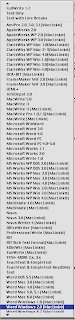
The list of supported export formats includes: Acta, AmiPro, AppleWorks, Claris Works, FrameMaker (yes), HTML+, InfoDepot, MacWrite 5, II, Pro, Word, MS Works, MultiMate (remember?), Nisus, OfficeWriter (remember?), Professional Write, RTF, SDM Writer (what the heck?), SunWrite, MORE 3.1 (!), TeachText, Text, WorkPerfect, WordStar (omigod), WriteNow, XYWrite ... and one or two more. Plus a few variations of each. It's the same list for file open as well. Plain text, which probably came from FWP rather than from the common translator tools, did the best job of preserving the outlines look and feel.

I opened up a MacWrite document and saw my old email address again: 4867991@mcimail.com.

Between my old apps, the free version of FullWrite and some fiddling with archivers it looks like I can rescue most of the old documents. Of course classic is mostly forgotten (does 10.5 allow Classic even on PPC machines?), so there's not much time for this. A few more years and I'd have given up on the FW files.

BTW, Word 2003 did a fine job opening the old WordPerfect docs and saving them as RTF.

Did I mention the install is 2.8MB? The core application is 768KB.

768KB. Once, giants walked the earth.

Update 11/6/10: I received an email from Roy Leban, who was a lead engineer on the original FullWrite project. He has several blogs, but they're updated infrequently.

Tuesday, July 31, 2007

Microsoft updates Remote Desktop Connection Client for Mac

I thought they'd semi-officially abandoned this client. Apparently not: Remote Desktop Connection Client for Mac 2.0 (Beta) - The Unofficial Apple Weblog (TUAW). Great news, I'll be using it.

LaunchBar revised

Michael Tsai tells us about LaunchBar 4.3. This is one of my favorite apps. It's no longer fashionable since there are similar free products for OS X, but it never causes me a bit of trouble and it does everything I need. I even try to learn new features occasionally. I like the way they tied in Spotlight too. I'll update to 4.3 -- I also like that I've never had a problem with an update.

Also, I have a weird trait that I like paying for good software.

BTW, there's still no comparable equivalent for XP, despite hordes of would-be imitators.

Update 8/1/07: Wow, what a staggering array of features! I'm going to try to learn some of them, starting with the calculator. If you hit cmd-spacebar to launch LB (Cmd-F inside LB for Spotlight), then if you type any digit the calculator starts up.

Update: Great article - how to get more out of Lauchbar.

Monday, July 30, 2007

Safe sleep is stupid -- and at last someone else is saying so

When I got my otherwise excellent iBook I noticed sleep on shutdown was broken, even when Spotlight doesn't mess it up more. Surprisingly few people crab about this, but now Joe Kissell has spoken up for all of us:

TidBITS: Stewing Over Safe Sleep

... The situation is different on more recent Apple laptops - every portable model starting with the 15-inch and 17-inch Double-Layer SuperDrive models introduced in October 2005. These models do have an ordinary sleep mode, just as before. But Apple's documentation warns you that when you put such a laptop to sleep (by closing the lid, for example), you must not move it until the power light has begun pulsating. During the first moments after you close the lid, when the light is on steadily, Mac OS X is busily copying the contents of your RAM to your hard disk in preparation for the possibility that your battery might later drain completely - forcing the computer into Safe Sleep mode. And during that time, when the disk is spinning, any untoward movement could cause damage to the hard drive mechanism. (You can also employ a command-line hack to force it to bypass the ordinary sleep mode and go directly into hibernation after saving the RAM, if you so desire; I discuss this a bit later.)

So far so good, but here's where the problems start. It takes more than a "moment" for your computer to write this hibernation file to disk and go to sleep. The length of time it takes is proportional to the amount of RAM you have installed. On my new MacBook Pro with 4 GB of RAM, it takes 49 seconds for the computer to sleep when Safe Sleep is active; with Safe Sleep turned off, it takes only 4 seconds. That's an enormous, and enormously annoying, difference.

Moreover, for each gigabyte of RAM you have, you effectively lose a gigabyte of storage space on your hard disk, because of the space required for this special RAM cache file. Given the higher cost and lower capacities of laptop hard drives, this space usage is a nontrivial issue. In essence, there's now both a performance penalty and a storage space penalty for buying the latest hardware and maxing out your RAM!

Even so, the inconveniences of Safe Sleep would be slight if Apple offered an easy way to turn it off. But as things stand now, you have to do this in Terminal...

... I remember being in the audience for a Steve Jobs keynote several years ago in which he was demonstrating wireless streaming video. A PowerBook was playing a video clip that was being streamed over an AirPort connection from another Mac. To show how robust this capability was, Steve closed the PowerBook's lid while the video was playing, putting the computer to sleep, and then, a few seconds later, opened it again to demonstrate how the video immediately picked up where it had left off. We all applauded: that's how seamlessly things were supposed to work.

You can't do that anymore - at least not without using an unsupported hack. You have to wait almost a minute before your laptop will sleep, during which time you should not be moving it around. Look, it's 2007 and I'm a Mac user; if I can't put my brand new computer to sleep and into its bag in less than 10 seconds, something is seriously wrong.

To add injury to injury, Apple dramatically shrank the sleep/power LED on the iBook, so it's darned hard to spot the pulsating power light now. I thought the loss of quick-sleep was related to the MacTel transition (XP laptops take forever to sleep) but Kissell tells us it's an Apple thing.

Thanks Joe, I thought I was alone ...

Friday, July 27, 2007

Firefox: One thing IE does far better -- and FF could do it to

There's one old, old, thing IE does that FF doesn't do. It's been bugging me for years, but now I'm gonna say it.

It's the damned, stupid, drag-and-drop behavior Firefox inherited from Netscape.

Here's what I get when I click on a URL in the Firefox and IE location bars, then drag and drop into a blog editor, Microsoft Word, the RTF edit box for in Firefox, anywhere ...

IE uses the page title for the URL text display. Firefox gives me the URL. (I think Safari does the same thing as FF and Camino definitely does the same thing as FF. I don't know about Opera or OmniWeb.)

I'm sure someone prefers the FF behavior. I think the IE behavior is 100 times better. Ok, a thousand times better.


Update 8/1/07
: I tried with OS X, turns out there's no drag-and-drop "insert title" behavior with Camino, Safari or (if I remember correctly) - Firefox. So it probably requires some OS cooperation too.

Remote control for OS X: Suddenly, coming out of the woodwork ...

What the heck?! I've been ranting about the crummy remote control solutions [1] for OS X desktops for years -- to no avail (of course, I'm not delusional you know). All of sudden, they're popping up all over. Desktop Transporter is more interesting that most because it's now been acquired by DevonTechnologies, a very well regarded OS X vendor. It's not a straight VNC port [1] so I'll probably take a look at it. I doubt anyone but Apple is going to really be able to make this work the way I want [3], so I probably have to wait to see how bad 10.5 will be -- but I'll give is a try.

Some info on Desktop Transporter: Version Tracker: 3.8 stars

BTW, in the course of looking at DT I came across this extensive Macintouch topic thread. Alas, if only Macintouch would implement feeds for their topic page. There's only one mention of DT, but they mention some I'm familiar with. See also:

Update 7/28/07: No luck. I installed DT on two machines. It seemed to connect, but then simply hung with a black screen preview and a persistent "connecting" message. One machine is on 10.4.9, the other on 10.4.10. Local network, all Apple equipment. The only funny thing is I use WDS (an airport extreme and an airport express). The app complained NAT sharing was not enabled, though that should only be needed for remote access and the two machines showed a green internal connection. Enabling NAT on the Airport Extreme made no difference. I don't have time to futz with it, so this one is a flop.

--

[1] I know about VNC ports. I'm sure DT is really a VNC based solution, but it sounds like the developer worked to make it a better fit for Apple's oddball VNC implementation. It will be interesting to see how it handles multiple monitor and fast user switching for example.

[2] I know about Timbuktu as well. It was great once, but nothing I've heard about them recently makes me think they've kept up with the OS X world. Last time I looked they didn't have the confidence to offer a trial version. I suspect they just couldn't get deep enough into the OS to be efficient after classic died.

[3] It would have to be deeply integrated with Apple's mixed vector/raster display technology, which means only they can write it.

Living with Access 2007: "Disabled Mode", Trust Center, and a Bug

I have to live with Access 2007 at work. It's a mixed bag. Some things from Access 2003 have been improved. On the other hand, I despise the ribbon bar. Other things have not been touched: Access tables links still use path names (argghhhh), links still break when paths change, scripted column values pass the script rather than the script result (produces very bad side-effects), you still can't link in a query so that you could use the query results, there are no "view" equivalents, etc, etc.

Some things are really nasty. Here's one from an unanswered question on an Access site:

Re: Query Access 2007 "Disbled Mode"

... When I run the Make Table Query it says in the lower left corner the following error:

"The action or event has been blocked by Disabled Mode".

Access 2003 and 2007 alike have this idiotic question you have to answer on startup -- something about enabling "risky" stuff. I can't figure out how to disable the question. I think it's related to this problem. In my case I needed to write the output of a script from an Access 2003 formatted file to a new Access 2007 formatted file.

So how does one fix this? A member of the borg tells one how to discover disabled mode status programmatically, but that's no help. This probably helps:

http://blogs.msdn.com/access/archive/2005/11/01/488022.aspx

... Disabled mode and the Office Trust Center are designed to make it easier for a user to make trust decisions in scenarios where scripts that launch Access do not come into play.

There are scenarios, where developers of a solution want to ensure that code in Access (startup form/ macro or otherwise) always executes. In such cases the recommended approach is to ensure that one or more of the following conditions are met:

  • The database is signed with a trusted certificate.
  • The database is installed in a trusted location.

By meeting these conditions, the code within the solution will always be enabled. In scenarios where neither of these conditions can be guaranteed, Access can be made to revert to its legacy behavior of a modal startup trust prompt, that will launch and execute code in the database or not open the file at all. To revert to this legacy behavior set the following registry key:

HKEY_CURRENT_USER\Software\Microsoft\Office\12.0\Access\Security\

Value: ModalTrustDecisionOnly = 1 (DWORD)

Okay, let's look into the trusted location:

Click the Microsoft Office Button Button image, and then click Access Options...

Click Trust Center, click Trust Center Settings, and then click Trusted Locations.

...If you want to create a trusted location that is not local to your computer, select the Allow trusted locations on my network (not recommended) check box.

Click Add new location.

 ... We recommended that you don't make your entire Documents or My Documents folder a trusted location. Doing so creates a larger target for a hacker to potentially exploit and increases your security risk. Create a subfolder within Documents or My Documents, and make only that folder a trusted location.

In the Path box, type the name of the folder that you want to use as a trusted location, or click Browse to locate the folder.

If you want to include subfolders as trusted locations, select the Subfolders of this location are also trusted check box...

So I did this and got the error message: "the path you have entered is not a valid location or cannot be used ...". I think I'm getting this because I use drive letter substitution to get around the age-old access problem of linked file path dependencies.

A Google search on the last suggests the same problem arises with network drives, despite the claim that Access will allow trusted access to network drives. So this is probably a bug.

So I gave up, changed my trust center settings to "show the message bar", exited Access 2007, changed the default file mode to Access 2002-2003, restarted, clicked "enable everything" and I was able to run the query.

TSclientX: replace Microsoft's Remote Desktop Client with one made for OS X

I use Microsoft's Remote Desktop Client to control XP machines at home and work and to connect to Windows Terminal Servers (Win 2003). The terminal services interactions in particular are awesome, there's nothing comparable in the OS X world. It's my top complaint about OS X -- that Apple has never even tried to match Microsoft's six-plus year old remote control technology. 

Microsoft's Remote Desktop Client works very, very well under XP. They even made a client for OS X, but they stopped updating it a while ago. It's increasingly flaky, though I use it with some success even under 10.4.10 on a MacTel. I doubt, however, that it will work at all under 10.5 (BTW, I don't expect 10.5 until the spring of 2008 -- projects that big don't slip by only a few months, if it ships in October 2007 it will be dangerous).

So I'm very interested in TSclientX - An alternative RDP Client for Mac OS X. Runs native on Intel. Alas, it requires X11 ..

TSclientX is a Windows Terminal Services client for Mac OS X.  It appears to be a regular Mac OS application but is in fact an assembly of free software working in concert to provide similar (better?)  functionality to the official Remote Desktop Connection from Microsoft. Additionally, there is a nice tidy VNC Viewer built right in as well.

What makes TSclientX interesting compared to other Mac RDP Clients?

- SeamlessRDP is brought to you by Cendio's SeamlessRDP component.   It was originally introduced in rdesktop 1.5 and just simply rocks...

- Stability and speed on Intel Macs (and PowerPC Macs for that matter)   has been found by many to be superior compared to the official  Mac RDP client.

The most interesting ingredients are:

rdesktop 1.5 - http://www.rdesktop.org
An open source client for Windows NT Terminal Server and Windows 2000/2003 Terminal Services

tsclient 0.148  - http://www.gnomepro.com/tsclient A frontend for rdesktop and other remote desktop tools

VNC Viewer 4.1.2 - http://realvnc.com Virtual Network Computing

libao 0.86 - http://www.xiph.org/ao A cross platform audio library with CoreAudio support.

The GUI uses an optimized GTK+ build, specifically compiled for TSclientX.  Like most Unix-derived software on the Mac, Apple's X11 is required...

Wednesday, July 25, 2007

Skim for OS X: From Klein to DeLong to me

Ezra Klein likes Skim. I can see why. I downloaded and installed the compact open source application, and even at version 0.51 it's sweet.

I'm an Acrobat guru -- but I'm not a fan. Adobe is not a great software house on XP, and they're truly weak on OS X. They ignore basic OS rules (such as not running as an admin user) and their application update process is profoundly broken. Let's not talk about their browser integration ...

So I know Acrobat Pro extremely well, including the esoteric bits, but I've avoided both the Pro app and the Reader on OS X. I use Preview, a suprisingly powerful application that's a bit short of PDF oomph. Skim adds real notes (not the weird image overlays Preview sort-of provides) and some nice PDF browsing capabilities -- and we're only at 0.51.

Skim looks very promising.

Blogger: Replacement for BlogThis!

I've had quite bad luck lately with the Blooger BlogThis! bookmarklet. It simply fails to open much of the time with both Firefox and Camino. On the other hand the Google toolbar for Firefox "Send To Blogger" function has been working quite well, and of course on the XP platform there's Microsoft's unrivalled "Live Writer" for both IE and Firefox.

Alas, Camino and Safari are left out in the cold, though the BlogThis! bookmarklet seems to work best when I try it with Camino.

Send To Blogger is no panacea though. There's still no category/tag support.

Tuesday, July 24, 2007

LiOn battery care: it's the heat

Apple has a page up on maximizing iPhone battery life. Some of its universally applicable to all portable devices, others apply to all iPods (see also). The list below includes the web site info, and some of my own superstitions. The item new to me is bolded ...
  • Heat. LiOn batteries are damaged by heat. (I don't know if extreme cold damages the battery or simply transiently reduces output.) Keep your iPod, iPhone or laptop cool, especially when charging. Temps over 95C will reduce lifespan, so avoid leaving it in car in the summer. (A LiOn battery that's very hot during charging may be malfunctioning, as in pre-explosive. Don't wait for it combust, get it replaced.)
  • Use the battery at least monthly. LiOn batteries don't like storage, they age even if they are never used, though this effect is less severe than it once was. If you buy a device that's been on-the-shelf for a year you should expect inferior battery performance.
  • Run the charge from 100% to about 15-20% and recharge. (I've read this elsewhere and it gets periodically repeated. Others say there's no real problem with frequent "top off" charges except that the "battery life prediction" becomes less accurate.) A full discharge every 1-2 months will make the battery indicator more accurate. LiOn batteries age faster if they're totally drained repeatedly.
  • Turn off bluetooth, 802.11, etc unless you need it.
  • EQ settings: "Adding EQs to playback uses more of your processor, since they aren’t encoded in the song. Turn EQ off if you don’t use it. If, however, you’ve added EQ to tracks in iTunes, you’ll need to set EQ to “flat” in order to have the effect of “off,” because iPhone keeps your iTunes settings intact. Go to Settings > iPod > EQ."