TidBITS: Freecycle: Disposing of Good Old Stuff
...I had heard about the Freecycle Network, an Internet service that connects people with stuff to give away with people who want free stuff, but until this point I had never tried it. It turned out to be extremely simple. I went to the Freecycle Groups page to find the Ithaca group, followed the link to its Yahoo Groups mailing list, subscribed, and read the ground rules (this is important, since some things - like the required Subject tags - are not inherently obvious to a newcomer), and then sent a pair of email messages to the list, describing the LaserWriter and photocopier.
Sunday, August 05, 2007
Freecycle: Given away free stuff
I've had a hard time giving away good stuff in the past. Next time I'll try this:

Saturday, August 04, 2007
FlickrDown: make Flickr tolerable
Flickr allows users to download full res images, but it's a tedious multi-click process. It's pretty clear from reading the help forums that Flickr/Yahoo discourages distribution of full res images using Flickr, so they make the process as painful as possible.
GMAN: FlickrDown to the rescue. This open source free app is downloading my SIL's (sister-in-law) photoset as I type, I'll dump them in iPhoto later today. There's a similar open source app for OS X apparently, but my son is occupying the iMac at the moment. This one seems quite fine.
GMAN: FlickrDown to the rescue. This open source free app is downloading my SIL's (sister-in-law) photoset as I type, I'll dump them in iPhoto later today. There's a similar open source app for OS X apparently, but my son is occupying the iMac at the moment. This one seems quite fine.
Friday, August 03, 2007
Google maps still route via 35W
I'm tracking how long it will take Google to correct route information between my office and Minneapolis. As of 8/3 they still route across our fallen I-35W bridge.
More interesting will be to see if Google will start including bridge quality and design metrics in their routes. Wouldn't you like to have a "avoid risky infrastructure" checkbox option? How about crossbones on I-35W type bridges with ratings of "deficient".
Google may be able to encourage some state governments to move investments forward ...
More interesting will be to see if Google will start including bridge quality and design metrics in their routes. Wouldn't you like to have a "avoid risky infrastructure" checkbox option? How about crossbones on I-35W type bridges with ratings of "deficient".
Google may be able to encourage some state governments to move investments forward ...
Thursday, August 02, 2007
Rescuing data from 1993: archival surprise and a FullWrite Professional shocker
[8/3/07: Corrected notes on the import/export translators]
I was tossing out old files, when I came across printed versions of some reviews I wrote in the early 90s for MD Computing, the Journal of Family Practice (when it was an academic journal), and a few other geeky doctor journals. I decided to see if I could actually get at the data.
The file formats weren't the big problem (ok, with one exception and a big surprise - below). The big problem was the archival format. When I wrote these articles in 1992 to 1993, (yes, 15 years ago!) I routinely zipped a folder of .... 124 kb.
The 15 yo archived files didn't travel well. Apple's built-in unzip simply reported and error and halted. Stuffit Expander gave me an immortal SPOD that sucked cycles and forced a power cycle restart. "The Unarchiver" complained about a file defect, but it did extract the files.
WinZip on XP did better, albeit with a security warning and there was some problem with unzipping to a directory. I was able to drag and drop the ingredients however.
I had a tougher go with mysterious blank icon 36 KB extension-free document that nothing could open. Text Wranger showed a mess of non-ascii charcters and the string "FWRTFWRT" in the header. I guessed it was some ancient StuffIt archive and dropped it on StuffIt Expander -- this time it did expand.
The files turned out to be some GrandView outlines (I didn't bother with those), some MORE 3.1 files, MacWrite II, WordPerfect 5.0, and .... an Ashton-Tate FullWrite Professional document. Oddly enough, my G5 iMac has copies of MacWrite II, MORE 3.1 and FullWrite buried away. Only FullWrite wouldn't run; it sent my CPU to 100% but wouldn't start.
A Wikipedia article, however, pointed to a freeware version of FullWrite Professional. I installed the once monstrous application that crushed my Mac SE years ago -- it took up 2.8 MB. Yes, that's an "M". Less room than a single JPG.
2.8MB.
It launched perfectly under classic running in OS X 10.4.10 on my G5. No error messages, nothing, just opened the file with an outliner beyond anything currently available on any Word Processor in 2007. Yes, Word 2007 (ummm, maybe 2GB to install?) has nothing like the old FW outliner.
My next surprise was the import/export list of an immense number of file formats. It took me a while to remember that MacOS Classic included an OS facility for file translation available to every application. The lists was further extended if one licensed MacLink Plus. It's a very impressive list, though the quality of the translation isn't great:
(click to see full sized image)
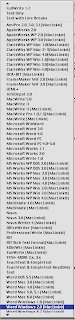 The list of supported export formats includes: Acta, AmiPro, AppleWorks, Claris Works, FrameMaker (yes), HTML+, InfoDepot, MacWrite 5, II, Pro, Word, MS Works, MultiMate (remember?), Nisus, OfficeWriter (remember?), Professional Write, RTF, SDM Writer (what the heck?), SunWrite, MORE 3.1 (!), TeachText, Text, WorkPerfect, WordStar (omigod), WriteNow, XYWrite ... and one or two more. Plus a few variations of each. It's the same list for file open as well. Plain text, which probably came from FWP rather than from the common translator tools, did the best job of preserving the outlines look and feel.
I opened up a MacWrite document and saw my old email address again: 4867991@mcimail.com.
Between my old apps, the free version of FullWrite and some fiddling with archivers it looks like I can rescue most of the old documents. Of course classic is mostly forgotten (does 10.5 allow Classic even on PPC machines?), so there's not much time for this. A few more years and I'd have given up on the FW files.
BTW, Word 2003 did a fine job opening the old WordPerfect docs and saving them as RTF.
Did I mention the install is 2.8MB? The core application is 768KB.
768KB. Once, giants walked the earth.
I was tossing out old files, when I came across printed versions of some reviews I wrote in the early 90s for MD Computing, the Journal of Family Practice (when it was an academic journal), and a few other geeky doctor journals. I decided to see if I could actually get at the data.
The file formats weren't the big problem (ok, with one exception and a big surprise - below). The big problem was the archival format. When I wrote these articles in 1992 to 1993, (yes, 15 years ago!) I routinely zipped a folder of .... 124 kb.
The 15 yo archived files didn't travel well. Apple's built-in unzip simply reported and error and halted. Stuffit Expander gave me an immortal SPOD that sucked cycles and forced a power cycle restart. "The Unarchiver" complained about a file defect, but it did extract the files.
WinZip on XP did better, albeit with a security warning and there was some problem with unzipping to a directory. I was able to drag and drop the ingredients however.
I had a tougher go with mysterious blank icon 36 KB extension-free document that nothing could open. Text Wranger showed a mess of non-ascii charcters and the string "FWRTFWRT" in the header. I guessed it was some ancient StuffIt archive and dropped it on StuffIt Expander -- this time it did expand.
The files turned out to be some GrandView outlines (I didn't bother with those), some MORE 3.1 files, MacWrite II, WordPerfect 5.0, and .... an Ashton-Tate FullWrite Professional document. Oddly enough, my G5 iMac has copies of MacWrite II, MORE 3.1 and FullWrite buried away. Only FullWrite wouldn't run; it sent my CPU to 100% but wouldn't start.
A Wikipedia article, however, pointed to a freeware version of FullWrite Professional. I installed the once monstrous application that crushed my Mac SE years ago -- it took up 2.8 MB. Yes, that's an "M". Less room than a single JPG.
2.8MB.
It launched perfectly under classic running in OS X 10.4.10 on my G5. No error messages, nothing, just opened the file with an outliner beyond anything currently available on any Word Processor in 2007. Yes, Word 2007 (ummm, maybe 2GB to install?) has nothing like the old FW outliner.
My next surprise was the import/export list of an immense number of file formats. It took me a while to remember that MacOS Classic included an OS facility for file translation available to every application. The lists was further extended if one licensed MacLink Plus. It's a very impressive list, though the quality of the translation isn't great:
(click to see full sized image)
 The list of supported export formats includes: Acta, AmiPro, AppleWorks, Claris Works, FrameMaker (yes), HTML+, InfoDepot, MacWrite 5, II, Pro, Word, MS Works, MultiMate (remember?), Nisus, OfficeWriter (remember?), Professional Write, RTF, SDM Writer (what the heck?), SunWrite, MORE 3.1 (!), TeachText, Text, WorkPerfect, WordStar (omigod), WriteNow, XYWrite ... and one or two more. Plus a few variations of each. It's the same list for file open as well. Plain text, which probably came from FWP rather than from the common translator tools, did the best job of preserving the outlines look and feel.
I opened up a MacWrite document and saw my old email address again: 4867991@mcimail.com.
Between my old apps, the free version of FullWrite and some fiddling with archivers it looks like I can rescue most of the old documents. Of course classic is mostly forgotten (does 10.5 allow Classic even on PPC machines?), so there's not much time for this. A few more years and I'd have given up on the FW files.
BTW, Word 2003 did a fine job opening the old WordPerfect docs and saving them as RTF.
Did I mention the install is 2.8MB? The core application is 768KB.
768KB. Once, giants walked the earth.
Update 11/6/10: I received an email from Roy Leban, who was a lead engineer on the original FullWrite project. He has several blogs, but they're updated infrequently.
Tuesday, July 31, 2007
Microsoft updates Remote Desktop Connection Client for Mac
I thought they'd semi-officially abandoned this client. Apparently not: Remote Desktop Connection Client for Mac 2.0 (Beta) - The Unofficial Apple Weblog (TUAW). Great news, I'll be using it.
LaunchBar revised
Michael Tsai tells us about LaunchBar 4.3. This is one of my favorite apps. It's no longer fashionable since there are similar free products for OS X, but it never causes me a bit of trouble and it does everything I need. I even try to learn new features occasionally. I like the way they tied in Spotlight too. I'll update to 4.3 -- I also like that I've never had a problem with an update.
Also, I have a weird trait that I like paying for good software.
BTW, there's still no comparable equivalent for XP, despite hordes of would-be imitators.
Update 8/1/07: Wow, what a staggering array of features! I'm going to try to learn some of them, starting with the calculator. If you hit cmd-spacebar to launch LB (Cmd-F inside LB for Spotlight), then if you type any digit the calculator starts up.Update: Great article - how to get more out of Lauchbar.
Monday, July 30, 2007
Safe sleep is stupid -- and at last someone else is saying so
When I got my otherwise excellent iBook I noticed sleep on shutdown was broken, even when Spotlight doesn't mess it up more. Surprisingly few people crab about this, but now Joe Kissell has spoken up for all of us:
TidBITS: Stewing Over Safe Sleep
... The situation is different on more recent Apple laptops - every portable model starting with the 15-inch and 17-inch Double-Layer SuperDrive models introduced in October 2005. These models do have an ordinary sleep mode, just as before. But Apple's documentation warns you that when you put such a laptop to sleep (by closing the lid, for example), you must not move it until the power light has begun pulsating. During the first moments after you close the lid, when the light is on steadily, Mac OS X is busily copying the contents of your RAM to your hard disk in preparation for the possibility that your battery might later drain completely - forcing the computer into Safe Sleep mode. And during that time, when the disk is spinning, any untoward movement could cause damage to the hard drive mechanism. (You can also employ a command-line hack to force it to bypass the ordinary sleep mode and go directly into hibernation after saving the RAM, if you so desire; I discuss this a bit later.)
So far so good, but here's where the problems start. It takes more than a "moment" for your computer to write this hibernation file to disk and go to sleep. The length of time it takes is proportional to the amount of RAM you have installed. On my new MacBook Pro with 4 GB of RAM, it takes 49 seconds for the computer to sleep when Safe Sleep is active; with Safe Sleep turned off, it takes only 4 seconds. That's an enormous, and enormously annoying, difference.
Moreover, for each gigabyte of RAM you have, you effectively lose a gigabyte of storage space on your hard disk, because of the space required for this special RAM cache file. Given the higher cost and lower capacities of laptop hard drives, this space usage is a nontrivial issue. In essence, there's now both a performance penalty and a storage space penalty for buying the latest hardware and maxing out your RAM!
Even so, the inconveniences of Safe Sleep would be slight if Apple offered an easy way to turn it off. But as things stand now, you have to do this in Terminal...
... I remember being in the audience for a Steve Jobs keynote several years ago in which he was demonstrating wireless streaming video. A PowerBook was playing a video clip that was being streamed over an AirPort connection from another Mac. To show how robust this capability was, Steve closed the PowerBook's lid while the video was playing, putting the computer to sleep, and then, a few seconds later, opened it again to demonstrate how the video immediately picked up where it had left off. We all applauded: that's how seamlessly things were supposed to work.
You can't do that anymore - at least not without using an unsupported hack. You have to wait almost a minute before your laptop will sleep, during which time you should not be moving it around. Look, it's 2007 and I'm a Mac user; if I can't put my brand new computer to sleep and into its bag in less than 10 seconds, something is seriously wrong.
To add injury to injury, Apple dramatically shrank the sleep/power LED on the iBook, so it's darned hard to spot the pulsating power light now. I thought the loss of quick-sleep was related to the MacTel transition (XP laptops take forever to sleep) but Kissell tells us it's an Apple thing.
Thanks Joe, I thought I was alone ...
Subscribe to:
Posts (Atom)